
Reviewed · SCAVENGER HUNTS
Copenhagen Royal Conspiracy Exploration Game and Tour
This Copenhagen Royal Conspiracy Exploration Game is interesting because it turns famous landmarks into a living map. You follow clues through the city center, starting at Amalienborg and ending near Kastellet. I like how the route strings together wildly different places in one smooth loop. I also like the quick context you get about what you are seeing, so you do not just collect photos. The one drawback to plan for is the game timer, it can start as soon as you open a clue, so you may feel pressure if you read first and wander later.
For most people, it is an easy way to get your bearings in Copenhagen on foot. It is also a private activity, meaning it is just your group moving through the challenge. Still, the story angle can feel a bit uneven, so treat it as a playful excuse to move, not a plot you have to fully decode.
Key highlights worth knowing before you start
- Timer starts when you open a clue, so walk first, read second
- Free entry is listed for each stop, so you mainly pay with time and attention
- You hit royal Rococo, churches, design, and a fortress in about 1.5 hours
- The route includes both landmarks and smaller details, not just the headline buildings
- Mobile ticket and English option make it simple to start
A clue-driven Copenhagen walk with royal and design stops
This is not a sit-and-listen tour. It is more like a guided stroll where your phone gives directions, and the city gives you the payoff. The game theme is royal conspiracy, but the real win is practical: you get a walk plan that carries you to major sights without needing to chart every turn yourself.
You will move between eight stops, and the time per stop is built into the experience at roughly 10 minutes each. That means you get enough time to look around, but you are not stuck there forever if you are on a tight schedule. If you prefer to keep moving and you like solving small puzzles, you will probably enjoy this format more than a standard guided group.
The route also covers a nice spread of Copenhagen moods. You start with royal grandeur at Amalienborg. Then you slide into church architecture, Russian and Danish flavors. After that, you get design culture at Designmuseum Danmark. Finally, you end with waterfront sights and a fortress that feels like Copenhagen has a secret defensive side.
Other hunts you can play across Copenhagen:
- Copenhagen: The Six Forgotten Giants Hunt and Nature Walk
★ 5.0 · 95 reviews - The Hunt For The Six Forgotten Giants
★ 5.0 · 45 reviews - Copenhagen Little Mermaid Exploration Game and Self-Guided Tour
★ 4.0 · 36 reviews
How the Royal Conspiracy game works on your phone
You will start at Amalienborg Slotsplads 5, 1257 København K, Denmark, and you will end at an exact finish location that you reach by solving all challenges and following directions in the app. That matters, because the ending point is not just a random landmark. It is part of the puzzle flow.
Your phone is the key. The experience is listed as having a mobile ticket, plus you follow directions and clues. So do not plan to wander without your device charged and ready. It is also offered in English, which helps if you want the story and instructions to match what you read.
One practical tip really improves the experience: the timer can start when you open a clue. That means you can lose time before you even reach the spot. Instead, walk toward the target first, then open and read the clue once you are close. It sounds like a small trick, but it turns the game from stressful into smooth.
Since this is a private activity, your group controls the pace a bit more. You still have the timer elements, but you are not waiting for other people to catch up in a big pack. It is a good fit if you want structure without crowds.
Amalienborg Palace: start with Danish Rococo flair
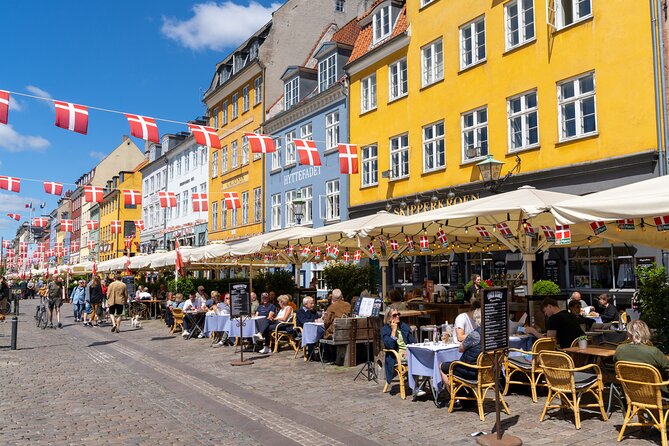
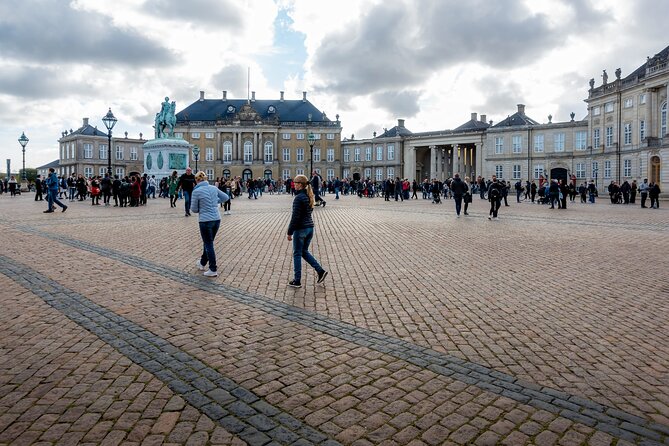
Your tour begins at Amalienborg Slotsplads, at Amalienborg Palace. This is the official residence of the Danish monarch, and the building is famous for Danish Rococo architecture. That is not just decorative hype. Rococo tends to show up in curves, ornamentation, and an elegant, almost theatrical look, and Amalienborg is one of the places in Copenhagen where you can see that style without needing an art history degree.
When you arrive, you are not just dropped at the front door. You reach it by following directions and solving a challenge. That first puzzle moment is useful. It gets you oriented immediately, and it nudges you to slow down and actually read the space around you instead of treating it as a quick photo stop.
You are free to spend as much time as you wish once you get there, until it is time to follow the next directions. That means you can take a moment to look at the facade and then step back to understand how the square opens up around you.
The only caution at the start is simple: if you open clue screens early and then drift, the timer can begin before you are ready. Do the walk first, then read, and you will feel in control from minute one.
Toldbodgade: a quick connector stop through central Copenhagen
The next listed stop is Toldbodgade. You are guided there the same way, through directions and clue-solving, and then you linger until it is time to move on.
Toldbodgade is useful because it fits Copenhagen’s center-to-waterfront rhythm. Even without spending ages here, a stop like this helps you understand the layout of the city. You get a sense of where streets run, how major sights connect, and how the waterfront approach changes the vibe as you head toward the harbor.
One practical point: short stops are where good shoe choices matter most. You are doing eight touchpoints over a limited time window. If you are wearing blister-prone footwear, this is when you will feel it.
Also, if the story part feels slightly confusing, that is okay. Focus on using these connector stops to guide your walking rhythm. The game mechanics will still deliver the right sight sequence even if the narrative angle is not your favorite.
A few more Copenhagen options worth comparing
- Half Day Self-Guided Audio Walking Private Tour in Copenhagen
★ 5.0 · 21 reviews - Monstour: A Self-Guided Audio Tour of Danish Folk Legends
★ 4.5 · 19 reviews - Copenhagen Self-Guided Murder Mystery Tour by the Round Tower
★ 4.0 · 11 reviews - Explore Copenhagen: Self-Guided Audio Tour
★ 4.0 · 8 reviews
Marble Church and Alexander Nevsky: two very different church stops
Then the game turns to church architecture, and it does so with big contrasts.
First up is Frederik’s Church, also known as the Marble Church. It is renowned for its Rococo architecture and the use of marble, which is exactly why it earned the nickname. The marble element is the visual signature, and the Rococo influence gives the building that slightly ornate, crafted look rather than a plain, heavy exterior feel.
Next comes St. Alexander Nevsky Church, the Russian Orthodox church in Copenhagen. This one gives you a different kind of landmark energy. Instead of a Danish Rococo marble statement, you get an Orthodox church identity with its own historical significance and distinct religious architecture.
Both stops are listed with about the same time allocation, and both are “look, absorb, and move” moments. The challenge here is attention span. You want to spend enough time noticing the materials and forms, but you also have to keep an eye on the game flow.
Here is a way to make it easier: pick one thing at each church and stick to it. At Marble Church, concentrate on the marble look and the Rococo style. At St. Alexander Nevsky Church, focus on the overall church impression and its historical presence. It turns two stops into a meaningful comparison instead of two quick snapshots.
Designmuseum Danmark: a breather that still fits the puzzle
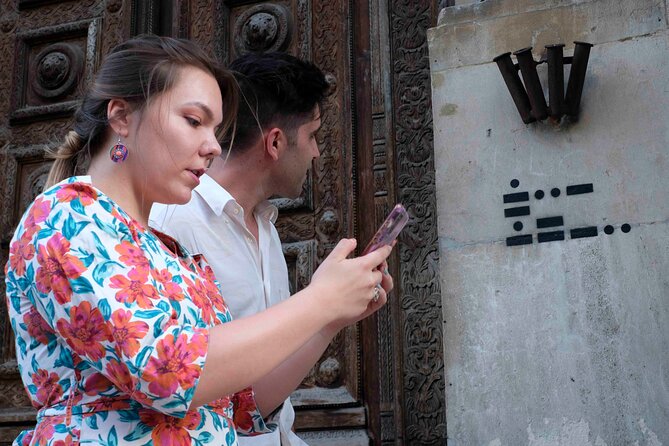
A lot of city games focus on exterior landmarks. This one also includes a cultural interior, and that is a smart move.
The route includes Designmuseum Danmark, Denmark’s largest museum for Danish and international design and crafts. It is described as housing a wide collection, including furniture, textiles, ceramics, and industrial designs. Even if you are not a museum person, a stop like this can reset your pace. You get a chance to cool down, sit for a minute, and shift from architecture appreciation to objects and materials.
The game time allocation for this stop is short, about 10 minutes. That means you should not plan on seeing everything. Instead, walk in with a simple mission: look for one category of objects and see what they tell you. Furniture if you like form and function. Textiles if you like color and pattern. Ceramics if you enjoy textures. Industrial design if you want to connect past design choices to the way things look today.
You are still doing the broader quest walk, but this stop adds real value because it gives you context for Copenhagen as more than postcards. Design is part of the city’s identity, and the museum is one of the best ways to experience that directly.
Nordre Toldbod and the waterfront mood shift
After the churches and museum, the route heads toward the waterfront, with Nordre Toldbod and Københavns Havn in the mix.
Nordre Toldbod is described as a historic area along the waterfront in Indre By, Copenhagen’s inner city. That phrasing matters. It tells you this is not just a promenade for a sunny day. It is a historical waterfront zone, and that shows up in how the area feels: the buildings and harbor edge can make you sense how the city worked and moved goods and people over time.
In a game that spends time on Rococo and religious architecture, bringing you to the harbor is a good balance. You get a change in scenery, a break in visual density, and a chance to orient your internal map. If you have been walking through streets and churches, waterfront air and open views can make the rest of the route feel easier.
Also, waterfront light can be tricky for photos. If you want photos that do not look washed out, watch the angle of the sun and stand slightly off to the side of the main walkway.
Gefion Fountain: a big landmark with a mythic prompt
Then you hit Gefion Fountain in Churchillparken. This is one of Copenhagen’s iconic landmarks and a popular tourist attraction, and the game makes good use of that.
The fountain depicts the Norse goddess Gefion, which gives it a built-in story hook. When a landmark has a clear myth connection, it is easier to remember what you saw after you leave. It also helps you understand why it is instantly recognizable to many visitors.
For this stop, take the common-sense approach: get a wide look first, then step in closer. From a distance, you see the structure and composition. Up close, you can notice details that are easy to miss if you only aim for the perfect shot.
If you are doing this as a quick solo puzzle walk, the fountain can feel like a reward stop. It is visually satisfying and it helps you transition into the final fortress phase.
Kastellet and King’s Gate: the finish with fortress energy
The last major listed stop is Kastellet 14A, specifically Kongeporten, the King’s Gate, which is one of the main entrances to Kastellet.
Kastellet is described as a historic star-shaped fortress and one of Northern Europe’s best-preserved fortifications of its kind. That is a mouthful, but it also tells you what to expect when you arrive. A star-shaped fortress has a geometry you can feel. Paths, angles, and ramp-like edges can make you understand the defensive logic even if you are not reading a history plaque.
The listed time is short, but the setting does the heavy lifting. When you step into that fortress vibe, you get open space and clear lines. It is the kind of landmark that can make your walking route feel complete, like you have covered the city from ceremonial power to practical defense.
One more game mechanic note: the end point is determined by solving all challenges and following app directions. So when you think you are “done” with Kastellet, keep your phone out until you hit the exact finish location.
If you get the final stage right, the last stop feels less like a random conclusion and more like a solved mission.
Price and time: is it worth $7.14 per person?
At $7.14 per person, this is priced in the world of small add-on experiences, not major paid tours. The value depends on what you want from Copenhagen.
If you like walking, puzzle games, and quick context, this pricing can feel fair because you are getting multiple major landmarks tied together into a guided route. The duration is about 1 hour 20 minutes to 1 hour 40 minutes, which is a realistic block for a concentrated city-center walk.
You also have a major value signal in the way the stops are listed: admission tickets are marked free at each point. That means you are not stacking separate ticket costs on top of the experience. It is a big deal for travelers trying to keep a tight budget.
Now the balanced part. You are paying for structure, not for guided commentary at length. If you expect a deep, ongoing storyteller or long museum time, you may find the game format too quick. The time per stop is short, so the experience rewards fast attention rather than slow drifting.
Also, because the timer can start early when you open a clue, your enjoyment is tied to how you manage the app. If you handle the timing smartly, the game feels efficient. If you ignore it, you might feel rushed at the exact moments you would rather linger.
Who this Copenhagen quest fits best
I think this experience is best for people who want a little challenge without committing to a full day. It is also a strong fit if you are traveling with a small group and you want private time while still benefiting from a planned route.
If you are the type who likes to learn by looking, you will probably enjoy the built-in extra facts attached to what you see. That is one of the most praised aspects of this kind of quest format, because it upgrades the walk from sightseeing to understanding.
It can also work well if you do not want to coordinate with a group schedule. You have a start point and an end point, and the app keeps you moving.
The main mismatch is if you dislike puzzle pressure. The timer mechanic can create a sense of urgency, especially in areas with lots of people around iconic stops. In that case, you can still do it, but you will want to treat it like a scavenger hunt and accept that you may not see every detail like you would on a slower self-guided wander.
Should you book the Royal Conspiracy Exploration Game?
Book it if you want an organized walk through Copenhagen’s top mix of royal architecture, churches, design culture, waterfront stops, and fortress shape without paying extra admission at each place. The price is low enough that you can take a chance, and the short duration makes it easy to slot into a day even if your schedule is tight.
Skip it if you want a classic guided tour with slow pacing and deep explanations at every stop. This experience is built for movement, not long museum hours. Also, if timer stress ruins your enjoyment, use the simple trick: walk close to the clue location first, then open it.
If you like city games, you will likely find this a fun way to see a lot of Copenhagen while keeping your own rhythm.
FAQ
How long does the Copenhagen Royal Conspiracy Exploration Game take?
It takes about 1 hour 20 minutes to 1 hour 40 minutes.
What language is the tour offered in?
It is offered in English.
Where do we meet, and how do we find the end point?
You start at Amalienborg Slotsplads 5, 1257 København K, Denmark. You reach the exact final location by solving all the challenges and following the directions from the app.
Do we have to pay admission for the stops?
The information provided lists admission ticket free for the listed stops.
Is this activity private?
Yes. It is a private tour or activity, and only your group participates.
Can we cancel for a full refund?
Yes, you can cancel for free up to 24 hours in advance for a full refund.
Recently reviewed around Copenhagen
- The Forgotten Giants Private Tour★ 5.0 · 3 reviews
- Explore Copenhagen in 60 minutes with a Local★ 5.0 · 3 reviews
- E-Scooter guided tours in Wonderful Copenhagen★ 5.0 · 3 reviews
- E Biking Adventure to Kronborg Castle★ 5.0 · 3 reviews
- Danish Design Classic and Modern Style Self-Guided Audio Tour★ 5.0 · 3 reviews
- Departure by Luxury Vehicule Copenhagen to Copenhagen airport CPH★ 5.0 · 3 reviews
- Copenhagen: Self Guided Scavenger Hunt and Tour★ 4.0 · 3 reviews
- Mikkeller Tastings – The Unusual Story of Beer and Mikkeller★ 5.0 · 3 reviews
Scavenger Hunts, compared.

Copenhagen Little Mermaid Exploration Game and Self-Guided Tour
Read our review →
The Six Forgotten Giants Trolls Hunt with Minibus
Read our review →
e-Scavenger hunt Copenhagen: Explore the city at your own pace
Read our review →

Self-guided Treasure Hunt Tour in Copenhagen – Build a Spaceship
Read our review →Self Guided Treasure Hunt and Sightseeing Tour in Copenhagen
Read our review →Browse the lists this tour appears in